
Previous
Next
How IoT Works with Hade Instruments: A Simple Guide to Smart Gas Management
1. Introduction
Industrial and commercial gas management is changing.
In the past, gas companies needed to read meters manually, handle prepayment cards on site, and respond to faults only after customers complained.
Today, IoT (Internet of Things) changes everything.
Hade Instruments integrates IoT into gas flowmeters, control valves, pressure sensors, and volume correctors — turning traditional gas equipment into smart, connected devices.
This article explains:
What IoT means for gas measurement
How Hade Instruments builds its IoT workflow
What benefits you can expect
2. What IoT Means for Gas Measurement
IoT is not a single technology.
It is a structure with three layers:
| Layer | What It Means | In Gas Applications |
|---|---|---|
| Things | Physical devices | Gas flowmeters, valves, pressure sensors, temperature sensors |
| Connection | Communication methods | NB-IoT, LoRa, 4G, RS485 |
| Network / Cloud | Data platform | Hade IoT Cloud Platform |
When these three layers work together, gas equipment becomes visible, controllable, and analyzable — anytime, anywhere.
3. Hade Instruments IoT Workflow — Step by Step
Here is how a typical Hade IoT system works, from field device to business decision.
Step 1 — Data Collection (Things)
Gas flowmeters (roots, turbine, ultrasonic), control valves, and pressure/temperature transmitters are installed at customer sites.
Each device continuously measures:
Gas flow rate (instant and cumulative)
Pressure
Temperature
Valve status
Battery level
✅ All Hade IoT-ready models are marked with "-W" suffix (e.g., HR-W, HTZ-W).
Step 2 — Data Transmission (Connection)
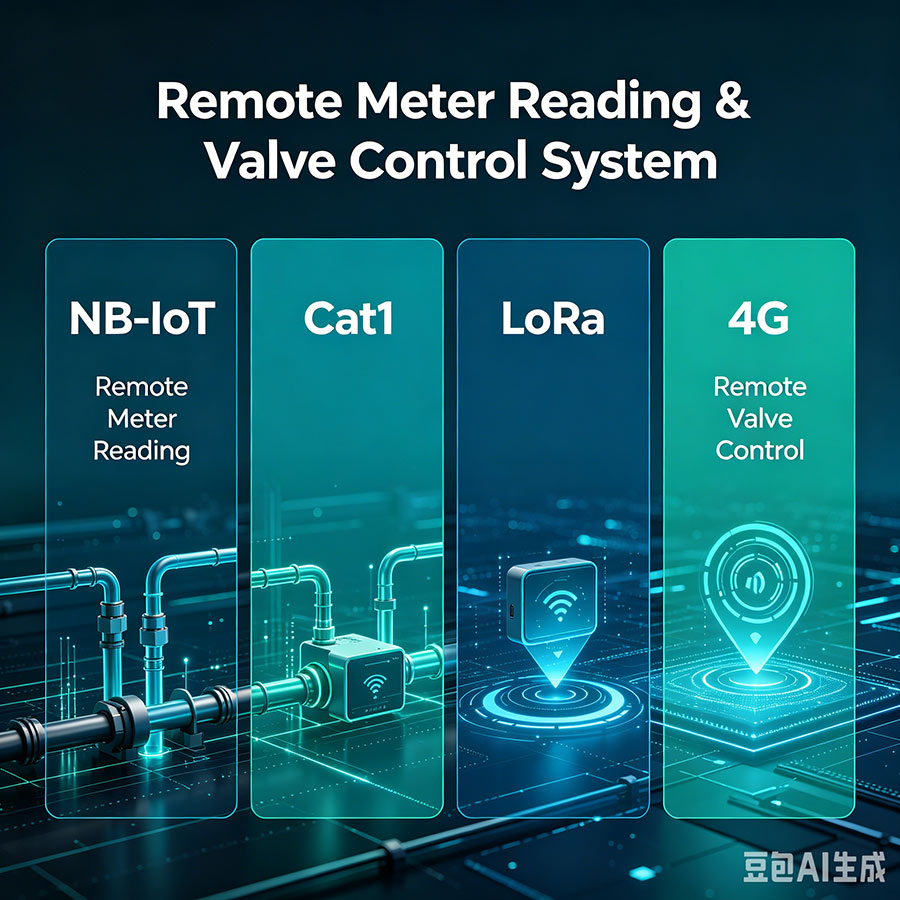
Data is sent to the cloud via:
NB-IoT / Cat1 —Large cover, low power, no extra gateway needed
LoRa — long distance, -based networks
4G — higher bandwidth, faster response
RS485 — wired connection for local SCADA systems
The transmission method can be selected based on site conditions and cost requirements.
Step 3 — Cloud Platform Processing (Network)
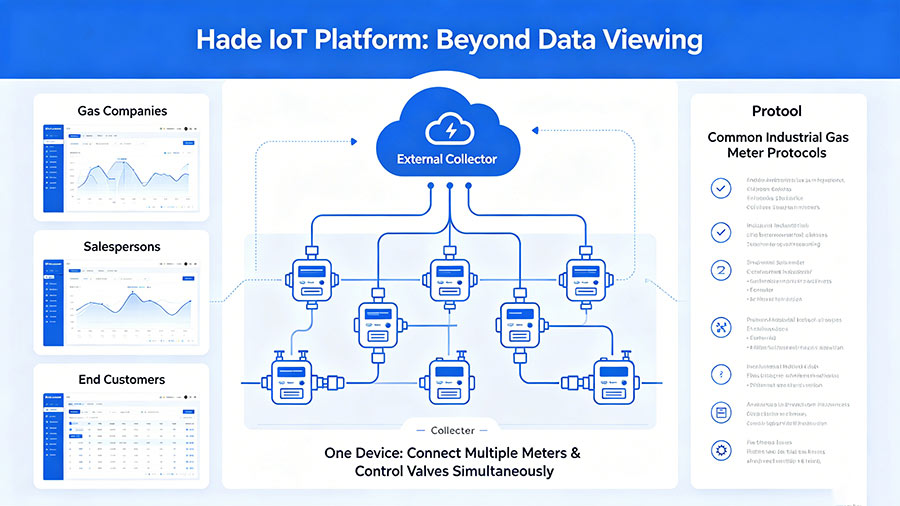
The Hade IoT Cloud Platform receives, stores, and processes the data.
Key capabilities:
| Function | Description |
|---|---|
| Multi‑protocol support | Compatible with common industrial gas meter protocols |
| Multi‑tenant architecture | One platform serves multiple gas companies separately |
| Role‑based access | Different views for admin, operator, end user |
| Data storage | Minute/hour/day/month records, configurable |
| Alarm engine | Pressure loss, low battery, flow over‑limit, valve abnormal |
Step 4 — User Application (Value Creation)
End users access the platform through:
Web browser (PC)
WeChat mini program (mobile)
API (third-party system integration)
What they can do:
View real-time gas consumption
Check remaining prepayment balance
Remote valve open/close
Receive alarms via SMS / app push
Export historical data for analysis
4. A Practical Example: Prepayment + Remote Shutoff
A typical Hade IoT smart gas solution for industrial users:
The gas company sets up a prepayment account.
The customer pays online.
The cloud platform sends a command to open the valve.
Gas flows. Flowmeter measures consumption.
Data is sent to the cloud every hour (or shorter).
When balance is low, an alarm is triggered.
If balance reaches zero, the valve closes automatically.
No physical card. No site visit.
Everything is managed remotely.
5. Architecture Overview: IaaS + PaaS + SaaS
Hade IoT platform is built on a standard cloud architecture:
| Layer | Role | In Hade Platform |
|---|---|---|
| IaaS | Infrastructure (servers, storage, network) | Provided by Alibaba Cloud / Tencent Cloud |
| PaaS | Platform (IoT middleware, protocol parsing) | Hade core IoT engine |
| SaaS | Software (user interface, reports, API) | Hade IoT web + mini program |
This means:
No need to build your own server room
Enterprise‑grade security and stability
Easy to scale as your business grows
6. Supported Devices (Hade IoT‑Ready Products)
| Product Type | Series | IoT Function |
|---|---|---|
| Gas Roots Flowmeter | HR-W / HRS-W | NB-IoT, 4G, LoRa |
| Gas Turbine Flowmeter | HTZ-W / HTME-W | NB-IoT, 4G, LoRa |
| Gas Vortex Flowmeter | HXZ-W | NB-IoT, 4G, LoRa |
| IC Card Control Valve | HFIC-W | Remote valve control + data upload |
| Pressure Transmitter | HD3105-W | Wireless pressure monitoring |
| Temperature Transmitter | HD248-W | Wireless temperature monitoring |
Other models can be upgraded with external data collectors.
7. Who Should Use Hade IoT Solutions?
| User Type | Main Benefit |
|---|---|
| Gas companies | Reduce meter reading cost, lower operation expenses |
| Industrial users | Real‑time consumption visibility, remote valve control |
| Project contractors | Easy integration into SCADA / energy management systems |
| Distributors | Value‑added IoT service for end customers |
8. Conclusion
IoT is not a future concept.
It is a practical structure that works today:
Things — reliable Hade gas meters and sensors
Connection — NB-IoT, LoRa, 4G, RS485
Network — Hade cloud platform
Whether you need remote reading, prepayment control, or industrial gas data analysis — Hade Instruments has a ready‑to‑use IoT workflow.