Gas Vortex Precession Flowmeter: Principles, Features, and Selection Guide
In natural gas metering across petroleum, chemical, and city gas industries, the choice of flowmeter directly impacts custody transfer fairness and operational efficiency. The gas vortex precession flowmeter has emerged as a key instrument in China's gas distribution networks, offering no moving parts, wide turndown ratio, and integrated temperature and pressure compensation. This article provides a systematic overview of its working principle, core features, technical specifications, and selection considerations.
Working Principle
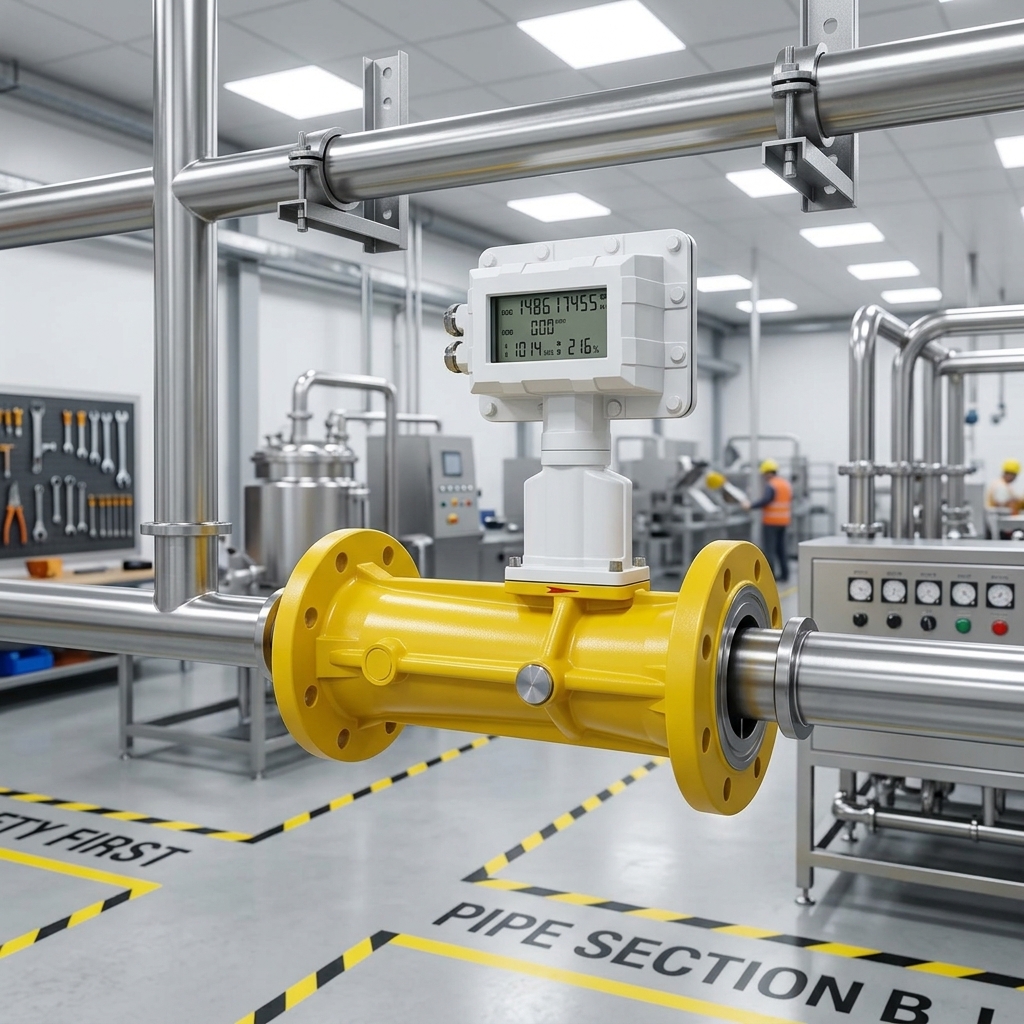
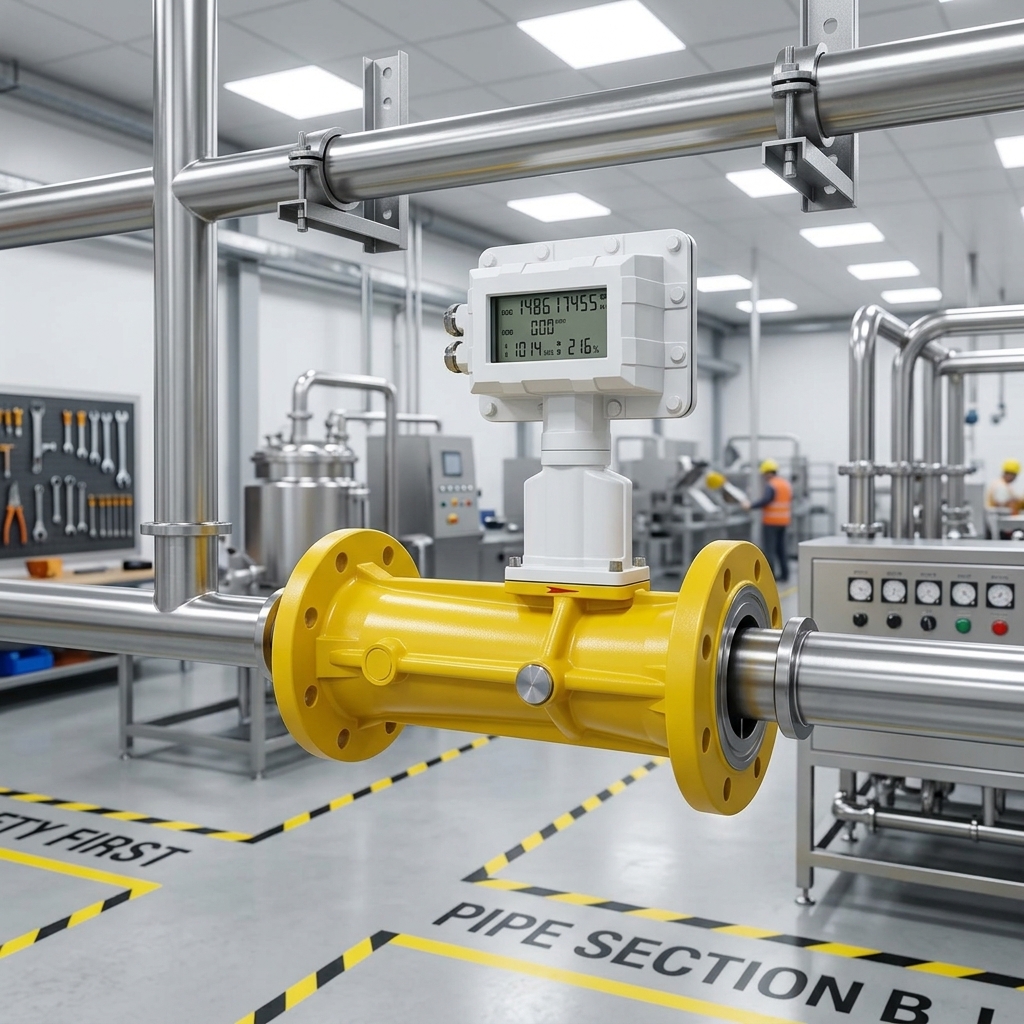
The gas vortex precession flowmeter operates based on the **vortex precession phenomenon** in fluid mechanics . Its flow profile resembles a Venturi tube, with a set of spiral guide blades installed at the inlet. When gas enters the sensor, the guide blades force the fluid into intense vortex flow . As the vortex flow enters the divergent section, backflow causes it to undergo secondary rotation, forming a gyroscopic precession motion.
This precession frequency is proportional to the flow rate and is independent of fluid physical properties and density . Piezoelectric sensors detect the precession frequency signal, which is then amplified, filtered, and shaped into a pulse signal proportional to flow velocity . Together with temperature and pressure signals, the data is processed by the microprocessor and displayed on the LCD screen as working condition flow, standard condition flow, cumulative total, temperature, and pressure readings .
Core Features
1. No Moving Parts – Low Maintenance
Unlike turbine flowmeters, the vortex precession flowmeter has **no rotating mechanical components**, making it corrosion-resistant, stable, and requiring no routine mechanical maintenance . This significantly reduces long-term operational costs.
2. Integrated Temperature & Pressure Compensation
The flowmeter integrates a **Pt100 platinum resistance temperature sensor** and a pressure sensor, enabling real-time detection of medium temperature and pressure . It automatically performs compressibility factor correction and directly displays standard-condition volume flow and total volume . This feature is essential for natural gas custody transfer, eliminating manual conversion errors.
3. Wide Turndown Ratio & Excellent Low-Flow Performance
The vortex precession flowmeter offers a high turndown ratio, typically **1:15 to 1:30 or wider** . With DN50 as an example, some models cover flow ranges from 10 to 150 m³/h or broader. Its dual-piezoelectric sensor design and intelligent anti-vibration technology effectively suppress interference from pressure fluctuations and pipeline vibration, ensuring excellent stability at low flow rates .
4. Multiple Output & Communication Options
The converter supports **pulse frequency output, 4-20mA analog signal**, and comes standard with an **RS485 interface (Modbus protocol)** for direct connection to host computers, with transmission distances up to 1.2 km . Paired with data collectors, it can form an automatic meter reading and management system via telephone or broadband networks.
5. Explosion-Proof Certification & Installation Flexibility
Both **flameproof (Ex db IICT4 Gb)** and **intrinsically safe (Ex ia IICT4 Ga)** versions are available for different hazardous area requirements . The meter head can rotate 180°~360°, allowing flexible installation orientation and convenient reading.
Technical Specifications
Flow Range by Diameter
| Nominal Diameter DN (mm) | Flow Range (m³/h) | Notes |
|---|---|---|
| 20 | 1.2 – 15 | Suitable for small flow applications |
| 25 | 2.5 – 30 | Wide coverage |
| 32 | 4.5 – 60 | — |
| 50 | 10 – 150 | Common specification; some models as low as 2.5 m³/h |
| 80 | 20 – 400 | — |
| 100 | 50 – 800 | — |
| 150 | 150 – 2250 | — |
| 200 | 360 – 3600 | Large diameter for main pipelines |
*Data compiled from multiple sources* .
Accuracy Class
System accuracy (after temperature and pressure correction) reaches **1.0% or 1.5%** , with repeatability less than one-third of the basic error limit. For high-accuracy custody transfer applications, **1.0% accuracy is recommended**.
Pressure Rating & Housing Material
Pressure ratings cover **PN1.6 MPa to PN16 MPa**, with higher ratings available upon request . Housing material selection:
- **≤2.5 MPa**: Aluminum alloy (die-cast aluminum)
- **≥4.0 MPa**: Stainless steel or cast steel
**For media containing corrosive components such as H₂S or CO₂, stainless steel is strongly recommended.**
Selection Guidelines
1. Match Diameter to Actual Operating Flow
Select based on pipeline pressure, medium temperature, flow range, and output signal requirements. **The operating flow should ideally fall within 20%–80% of the full range** to achieve optimal performance.
When flow rate is given in standard-condition volume, convert to working-condition volume using:
> **Qv = QN × (PN / (Pa + P)) × (T / TN)**
Where: Qv = working flow, QN = standard flow, Pa = local atmospheric pressure, P = gauge pressure, T = absolute temperature, TN = standard absolute temperature (293.15K) .
2. Consider Minimum Flow Limitations
For small daily consumption users (e.g., below 200 m³/day), even the smallest diameter (DN20) may not guarantee accurate measurement. Alternative solutions such as diaphragm gas meters should be considered.
3. Exercise Caution for DN80 and Above
**For nominal diameters ≥DN80, vortex precession flowmeters show relatively larger measurement errors**. Industry guidelines recommend that the selected flowmeter diameter generally should not exceed DN50 . For large-diameter metering points with daily flow exceeding 1.5×10⁴ m³/d, consider advanced orifice plate metering devices with smart transmitters.
4. Explosion-Proof & Protection Rating
Select appropriate explosion-proof type based on hazardous area classification, and ensure **IP65 or higher** for outdoor installation .
5. Optional Configurations
Consider whether the following features are needed:
- Temperature & pressure compensation
- Output signal type (pulse / 4-20mA / RS485)
- Power supply (internal battery / external power)
- HART protocol communication
Installation & Maintenance
Straight Pipe Requirements
The vortex precession flowmeter requires **shorter straight pipe sections** than orifice plate meters: **upstream ≥3DN, downstream ≥1DN** . This simplifies installation in space-constrained environments.
Vibration Considerations
While the flowmeter has anti-vibration capability, **strong mechanical vibration can still affect accuracy** . For installations in high-vibration environments, consider using rubber sleeves and shock-absorbing mounts to dampen vibration .
Maintenance
The flowmeter requires **no routine mechanical maintenance** due to its no-moving-parts design. Periodic battery replacement and parameter verification are recommended . **For custody transfer applications, recalibration every 1-2 years is strongly recommended** .
Conclusion
The gas vortex precession flowmeter excels in small-to-medium diameter natural gas metering applications, offering no moving parts, integrated temperature and pressure compensation, wide turndown ratio, and good low-flow performance. It has become an important choice for China's natural gas distribution and industrial gas metering.
**However**, for metering points with nominal diameters **≥DN80** or daily flow exceeding **1.5×10⁴ m³/d**, alternative solutions should be carefully evaluated. Final selection should consider pipeline pressure, flow range, medium characteristics, installation environment, and investment cost — ideally with guidance from technical professionals.